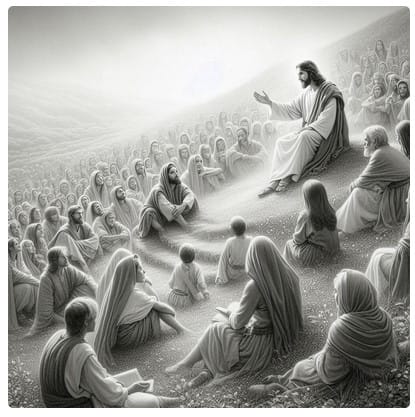
The Growth Factor of the Beatitudes – the Blesseds
Everyone who has spent serious time studying the words of Yeshua knows, at least in general, what the “Beatitudes” are. The Blesseds. The beatitudes are found as part of “The sermon on the Mount” in Matthew chapter 5.
The word beatitude means extremely blessed or a state of supreme blessedness. It comes from the Latin word “beatus”.
The Father Draws us to Yeshua
Being called to Yeshua is a “blessed”! And we are called, praise GOD! The Father draws us to Yeshua and there is no other way to The Father except through Yeshua.
In Matthew chapter 6, verse 44, Yeshua says, “No one can come to Me unless the Father who sent Me draws him; and I will raise him up on the last day. It is written in the Prophets: ‘AND THEY SHALL ALL BE TAUGHT OF GOD;’ Everyone who has heard and learned from the Father, comes to Me. Then in chapter 14, Yeshua says, “I am the way, the truth, and the life; no one comes to The Father except through Me.”
The Beatitudes Seem to be Spiritual Attributes that We Grow In
I have read different teachings on The Beatitudes and I’ve spent a fair amount of time in them; not as much time as I should have and wish that I had for the number of years that I’ve been on this earth. Nothing I read about in those teachings on The Beatitudes meanings seems to stay with me or cause an “aha”. Then the other day as I was dwelling in them, it seemed that some understanding came. As I looked at The Beatitudes one more time, it fit and I believe it might fit for you. Try it on and see:
I believe that The Beatitudes are the layers of spiritual growth that build our life in The Kingdom of GOD; the house built on the foundation of Yeshua’s words – As He taught in a parable. The foundation is laid when we trust Yeshua; are born again. As we apply His words, The Beatitudes speak to the house built (life built) as our heart goes through reformation or the journey into a mature Halakhah1 or Derech2.
It seems to me that when we realize that we are lost, living to self; that we need Yeshua, want to have a “with GOD” life, live His way – that we come poor in spirit. Poor in our spirit implies realization of how much we need GOD, that we don’t have all of the answers to life; but He does! We’ve been trying life our way, ruling our own little kingdom but it’s not satisfying us; it’s not filling that hole in our heart. We need to be in submission to GOD’s Spirit, His ways; living in His Kingdom, under His rule. Yeshua came saying, “Repent for the Kingdom of Heaven is at hand.” It is available. Give up the proud self-governing, self-ruling, gotta’ have it my way kingdom. Later Yeshua tells His Disciples in chapter 16 of Matthew: “If anyone would come after me, let him deny himself and take up his cross and follow me.”
The first beatitude:
- “Blessed are the poor in Spirit for theirs is the kingdom of heaven.”
 Coming to Him poor in spirit and truly repentant brings mourning for our sin. He forgives but when we discover His gospel of the kingdom of GOD and have that heart change, His love brings about regret, remorse, a mourning that we have been living by the world’s standards instead of GOD’s standards. Remorse for past sins is part of repentance. Repentance is turning from a selfish sin way of life to live GOD’s way. There will be mourning that we wasted time given to us living that way. BUT we have comfort in His forgiveness. We still have regret that we did not find the path to discipleship in Yeshua sooner.
The second beatitude:
- “Blessed are those who mourn for they will be comforted.”
As we move along our path to discipleship, we should be growing in meekness. “Meekness is strength under control or power harnessed for a higher purpose rather than passive weakness or timidity. It involves choosing gentleness, humility, and patience, acting with restrained strength to serve others and honor God.”3 Meekness resists urges to dominate and retaliate. It is a sign that we are growing in our relationship with Yeshua, The Father, and The Holy Spirit. The world’s way of being in control implies domination – one person over another – one country over another, strength is ruling by force. GOD’s way, The Kingdom of Heaven way is the opposite.
The third beatitude:
- “Blessed are the meek (sometimes translated as gentle), for they will inherit the earth.”
Growth in our walk with GOD, studying the words of Yeshua, brings a hunger for more understanding; a hunger to be closer; more in tune with GOD. We seek to hear and recognize His voice. We seek to know The Father and the one He sent, Yeshua the Messiah. Knowing Them, having that relationship with Them is eternal life; see John 17. The Father wants that relationship also. In John 3:16, “For GOD so loved (agape) the world that He gave His only son, so that everyone who believes (entrusts one’s spiritual well being) in Him will not perish (be utterly destroyed), but have eternal life (see Strong’s numbers G25 –aionios for the English translation “eternal” and G2222 – zoe for “life”). This is the same Greek for eternal life, as in John 17.
The fourth beatitude:
- “Blessed are those who hunger and thirst for righteousness, for they will be filled or satisfied.”
 As our heart changes; as we become more like Yeshua, grow in our understanding and become better disciples, we will be merciful to others just as The Father and Yeshua are merciful to us and to others. When Yeshua taught His disciples to pray in Matthew 6, the prayer included “…Forgive us our debts, transgressions, or sins (in different translations), as we forgive or have forgiven our debtors (those that have sinned against us)” He went on to say “…For if you forgive other people for their offenses, your heavenly Father will also forgive you. But if you do not forgive other people, then your Father will not forgive your offenses.” Between those two passages is “Lead us not into temptation but deliver us from evil.” The LORD’s prayer deals with mercy from GOD for forgiveness of our sins, mercy from us to others that do us wrong, and asking GOD’s grace for avoidance of sinful situations. As we grow in discipleship, we should want everyone to seek GOD’s forgiveness and in our heart we will be forgiving toward others just as GOD is.
The fifth Beatitude:
- “Blessed are the merciful, for they will receive mercy.”
The layers of discipleship and growth to be more like Yeshua will show up as we seek Him and His teachings. We’re not looking for “cheap grace”. It’s not about just believing that Yeshua died for our sins; just believing that He did something. It’s about believing that He is the Son of GOD; He has been given authority over all mankind. It’s believing that somehow His death and resurrection took the sin of those who trust Him to the cross with Him. It’s believing and trusting Him for the right way to live; He has the words of eternal life. It’s seeking a pure heart; a heart like Yeshua. Discipleship includes praying for, seeking, developing a pure heart. When David was to be king, part of what Samuel said to Saul refers to David being a man after GOD’s heart. I Sam 13:14 – But now your kingdom shall not endure. The LORD has sought for Himself a man after His own heart, and the LORD has appointed him ruler over His people, because you have not kept what the LORD commanded you.”
The sixth Beatitude:
- “Blessed are the pure in heart, for they shall see GOD.”
There is worldly peace and there is the peace of Yeshua. Then there is the word “peace” that was chosen to be used in The Bible as a translation for the Hebrew “shalom” in the Old Testament and the Greek “eirene” in the New Testament. When “peace” or any other singular English word was chosen by translators, the depth of meaning of the Hebrew and Greek words did not come through. We just do not have a singular English word to accomplish that. Let’s unpack the beatitude: “Blessed are the peacemakers, for they will be called sons of God.” The word for “peacemakers” is “eirēnopoios”. This is the only time it occurs as a word in The Bible. It is a combination of eirene and poieo.
Poieo means “to make” or “to do”. It implies creating, constructing, or bringing something into existence. It often refers to fulfilling, practicing, or performing actions. It suggests active engagement, sometimes translated as “practicing” or “doing” a certain way of life.4
Eirene occurs 92 times in the New Testament. Eirene was translated as peace 91 times and as secure once. Eirene is the Greek translation of Shalom. The two words are synonyms in different languages. In the NASB, Shalom is found in the Old Testament 242 times. Shalom and Eirene carry much more depth of meaning than our English word “peace” carries.
Both shalom and eirene represent blessedness, soundness, completeness, connection to GOD, wholeness, well-being, prosperity, and safety. The words carry the implication that all is well, nothing is broken, all is complete and nothing is missing or in lack. Shalom implies harmony between GOD and man, and among people. When doubled, it refers to “perfect peace” or the best possible state of peace. Both words are a state of blessedness or a beatitude in themselves.
If we do not do some inductive studying on our own then we are trusting our understanding of the Word to be whatever word was chosen as a translation. Not only can that leave us with a misunderstanding sometimes but usually GOD’s Word gets into us better if we dig around in it.
Within those 242 times that shalom is found in the Old Testament, it was translated as:
| Peace: | 170 times or 70 % |
| Is well, well-being: | 19 times or 8% |
| Welfare: | 9 times or 3.7% |
| Safe, safety, safely: | 6 times or 2.5% |
| Greet: | 6 times or 2.5% |
| Prosperity: | 3 times or 1.2% |
| Friendly terms: | Twice for 1 translation -doubled |
| Close [Friend(s): | Twice for 1 translation – doubled |
| Trusted [friend(s): | Twice for 1 translation |
| Favorable: | 1 |
| Be at ease: | 1 |
| Rose early: | 1 |
| How (learn how): | 1 |
| Secure: | 1 |
| Health: | 1 |
| Wholly: | 1 |
In John 14:27, Yeshua said to His disciples: “Peace I leave you, My peace I give you; not as the world gives, do I give to you. Do not let your hearts be troubled, nor fearful.”
The seventh Beatitude:
- “Blessed are the peacemakers, for they will be called sons of God.”
Yeshua then talks about the disciple being persecuted. When you are a disciple of Yeshua, following his teachings, living in the kingdom, you are at odds with the world. You are seeking the righteousness of living GOD’s way to the point that you hunger and thirst for it. You are probably going to be persecuted in some way. Persecution comes in all kinds of ways, some much more harmful than others. Persecution in Matthew 5:10-12 is a translation of the Greek word “dioko”. Interestingly, dioko is found in the New Testament 48 times and in three of the gospels 13 times. Mark does not contain the word dioko. According to Strong, the word means to flee, to pursue, and by implication to persecute. It is used positively or negatively to describe the pursuing of something you want or to harass and cause harm to someone. When Yeshua sent the 12 apostles out 2 x 2, part of His instructions were, “But whenever they persecute you in one city, flee to the next; for truly I say to you, you will not finish the cities of Israel until the Son of Man comes.” And then in John 15:20 “Remember the word that I said to you, ‘A slave is not greater than his master.’ If they persecuted Me, they will persecute you as well; if they followed My word, they will follow yours also.”
We should not think it strange that some people will be uncomfortable around us if you are disciples of Yeshua. Some will avoid us if possible. Many of us have no idea what real persecution is, the kind that Yeshua endured or the apostles and early disciples. There are those in some areas that now are being persecuted even to death. We should pray for those that are being persecuted in the world AND those that are persecuting them.
Further down in the sermon that Yeshua gave in this chapter of Matthew, past the beatitudes, we find related verses:
Matthew 5:43- 48:
“You have heard that it was said, ‘YOU SHALL LOVE YOUR NEIGHBOR and hate your enemy. But I say to you, love your enemies and pray for those who persecute you, so that you may prove yourselves to be sons of your Father who is in heaven; for He causes His sun to rise on evil and good, and sends rain on righteous and unrighteous.”
“For if you love those who love you, what reward do you have? Even the tax collectors, do they not do the same? And if you greet only your brothers what more are you doing than others? Even the Gentiles, do they not do the same? Therefore you shall be perfect, as your heavenly Father is perfect.”
If those that are being persecuted are to pray for their persecutors, surely we can pray for them and with them.
Growth as a disciple of Yeshua will more than likely produce persecution of one nature or another. Remember what He said “If they persecuted Me, they will persecute you as well; if they followed My word, they will follow yours also.”
The eighth beatitude:
- “Blessed are those who have been persecuted for the sake of righteousness, for theirs is the kingdom of heaven.Blessed are you when people insult you and persecute you, and falsely say all kinds of evil against you because of Me. Rejoice and be glad, for your reward in heaven is great; for in this same way they persecuted the prophets who were before you.”
May you grow in all of the beatitudes, in His grace and truth. May you be blessed and be a blessing in and by GOD’s Kingdom.
Our desire at It’s a Heart Matter is to be a blessing to you by these words. May you be blessed by this blog.
~~~~~~~
1 Halakhah – a Rabbinic word from the root H1980. Definition – How to conduct one’s self with obedience to and in accordance with divine will. H1980 appears in the Old Testament over 500 times.
2 Derech – Strong’s # H1870. Definition: Literally – a way, road, path, journey. Figuratively – manner or course of life or moral character. It is in the Old Testament 700 times, used both literally and figuratively.
3“Definition of meekness” prompt. Gemini, 5 Feb. 2026 version, Google, 5 Feb. 2026, gemini.google.com/
4 “Greek definition poieo” prompt. Gemini, 5 Feb. 2026 version, Google, 5 Feb. 2026, gemini.google.com/